
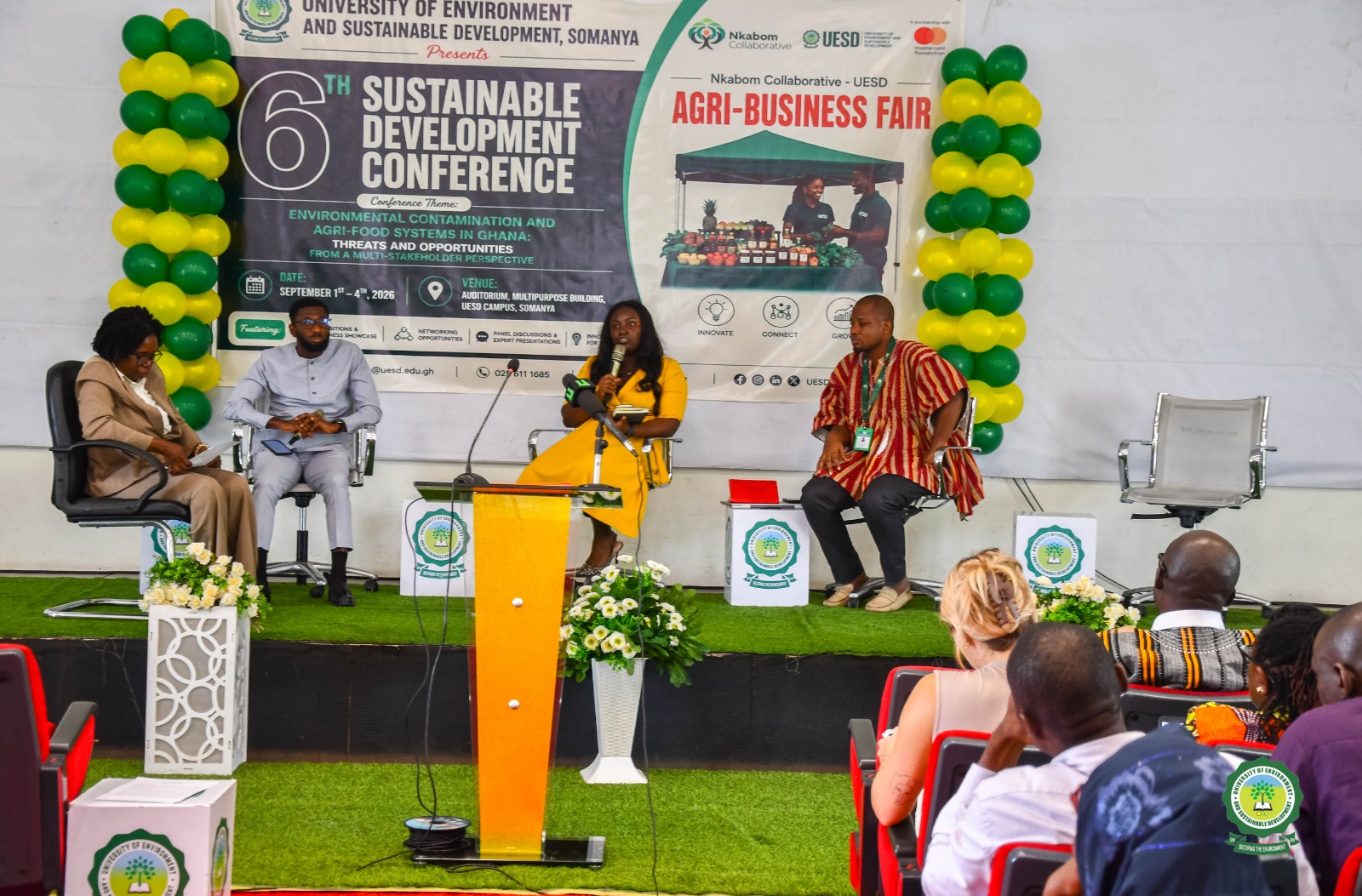
The need for urgent, coordinated, and sustained action to protect Ghana’s water resources, strengthen food safety, and create new economic opportunities for young people took centre stage as experts, researchers, regulators, and development practitioners engaged in critical discussions at the 6th Sustainable Development Conference of the University of Environment and Sustainable Development (UESD), Somanya, Eastern Region. It was on the theme “Environmental Contamination and Agri-Food Systems in Ghana: Threats and Opportunities from a Multi-Stakeholder Perspective.”
The plenary and policy sessions on the second and third days of the conference examined some of the most pressing challenges confronting Ghana’s environmental and food systems, including environmental contamination, declining water quality, food traceability, post-harvest losses, inadequate cold-chain infrastructure and limited opportunities for youth participation in agriculture and agribusiness.
At the heart of the discussions was a growing concern that environmental degradation can no longer be treated as an isolated environmental issue. Its effects extend directly into agriculture, food safety, public health, livelihoods and the broader national economy.

During a plenary session on environmental contamination and agrifood systems, panellists examined the consequences of the degradation of soils and contamination of surface and underground water resources through human activities. The discussion highlighted how contamination at one point in the environmental system can have far-reaching consequences for ecosystems, agricultural production and communities whose livelihoods depend on natural resources.
The session, moderated by Dr. Theodora A. Asiamah of the Department of Sustainable Development and Policy, brought together Prof. Gibrilla Abass of UESD, Ms. Winner Wendy Anane, Extractive Sector Safeguards Officer at Aroch Ghana, and Dr. Ebenezer Afriyie, a Food Systems Specialist with UG-Nkabom. The experts called for stronger enforcement of environmental laws and regulations, increased investment in research and sustained technical and institutional interventions to address the causes, pathways and effects of environmental contamination. They stressed that isolated interventions would not be enough to resolve a problem that cuts across environmental, agricultural and public health systems. The message was clear: protecting Ghana’s natural resources requires collective responsibility. Government institutions, academia, industry, communities and other stakeholders must work together, supported by research, effective regulation and public education.
A multi-stakeholder panel on food traceability and standard enforcement brought together representatives from the Ghana Standards Authority, Council for Scientific and Industrial Research–Water Research Institute, Food and Drugs Authority and Environmental Protection Agency. The discussion examined how regulatory institutions can ensure that food and other consumer products entering the Ghanaian market meet required safety and quality standards.
Food traceability emerged as a critical component of consumer protection. Participants emphasised the importance of being able to track food from its source through processing, distribution, and sale to the final consumer. Product registration, proper labelling and batch numbers were identified as important tools for tracing products when safety or quality concerns arise.
However, the discussion acknowledged that traceability remains more challenging for fresh and informally traded food products, where information about the source, producer and handling practices may not always be readily available. Participants therefore called for improved systems for documenting food along the value chain, stronger collaboration among regulatory institutions and consistent enforcement of standards across both formal and informal markets.

Beyond the immediate challenges, the conference explored opportunities for turning problems within Ghana’s agricultural system into sources of innovation, enterprise and employment.
A second plenary discussion focused on agricultural by-product valorisation, solar-powered cold chains and infrastructure gaps affecting young people. The session explored how materials that are often discarded-including eggshells, fish heads, bones, skins, scales and other agricultural residues—could be transformed into useful products such as animal feed, soil amendments and other value-added inputs.
The discussion presented waste not simply as an environmental burden but as a potential economic resource. With appropriate research, technology, investment and partnerships, agricultural and fish-processing by-products could support new enterprises, generate additional income and create employment opportunities, particularly in rural and agricultural communities.
The panel, moderated by Dr. Kwaku Adu of UESD and featuring Dr. Richard Amfo-Otu, Head of the Academic Planning and Quality Assurance Unit at UESD, and Mr. Kofi Agboga, Executive Director of Yen Mpoano Ghana, also examined the infrastructure challenges contributing to post-harvest losses.
Particular attention was paid to cold-chain infrastructure for perishable agricultural and fish products. Solar-powered cold-storage facilities were identified as a promising option for production communities where reliable electricity remains a challenge. However, the experts stressed that successful cold-chain systems must go beyond refrigeration to include dependable energy, storage, transportation, processing, market access and maintenance. For the youth, the message was equally direct: national challenges can become opportunities for enterprise and innovation.
Participants encouraged young people to identify pressing development problems and build businesses, technologies and practical solutions around them. They also urged young entrepreneurs to actively pursue grants, internships, mentorship, research collaborations and private-sector investment. Blended financing involving government, development partners, the private sector and financial institutions was proposed as one way of supporting sustainable youth-led ventures.
The discussions ultimately pointed towards a more integrated approach to agricultural development—one that links production with waste valorisation, renewable energy, cold-chain infrastructure, processing, transportation, markets, research and youth entrepreneurship. Such an approach, participants noted, could help Ghana reduce post-harvest losses while creating jobs and building more resilient agricultural value chains.
Perhaps the most urgent discussion centred on Ghana’s water bodies and the impact of environmental contamination, particularly illegal small-scale mining.
A policy dialogue on the impact of environmental contamination on water bodies brought together researchers from the Ghana Atomic Energy Commission and a representative of the Community Water and Sanitation Agency. Moderated by Prof. Gibrilla Abass of UESD, the session examined the implications of polluted water resources for public health, food security and sustainable development.
The dialogue highlighted the deteriorating condition of some of Ghana’s rivers and other water bodies and underscored the country’s dependence on both surface and groundwater for domestic use, agriculture and livelihoods. The experts noted that contaminants from mining and other human activities can move through environmental systems, with some taking considerable time to reach groundwater and making remediation particularly difficult.
The experts raised concerns about the movement of pollutants, including potentially toxic substances and heavy metals associated with mining, through aquatic ecosystems and the food chain. Contaminated water used for irrigation can expose crops and, ultimately, consumers to harmful substances, with environmental degradation also affecting fisheries, agriculture, livelihoods and human health.
The conference therefore called for a coordinated national response involving government, academia, research institutions, traditional authorities, the private sector, the media, civil society and local communities. Stronger enforcement of environmental regulations, adequate resourcing of relevant institutions, public education and practical alternative livelihoods for communities engaged in illegal mining were identified as necessary components of the response.
The media was also encouraged to intensify responsible investigative reporting and public education on environmental issues, reinforcing the view that protecting Ghana’s natural resources is not solely the responsibility of regulators or environmental institutions.
Participants were from Ghana, including UESD staff and students, Nigeria, South Africa, the United Kingdom, and the United States of America.