
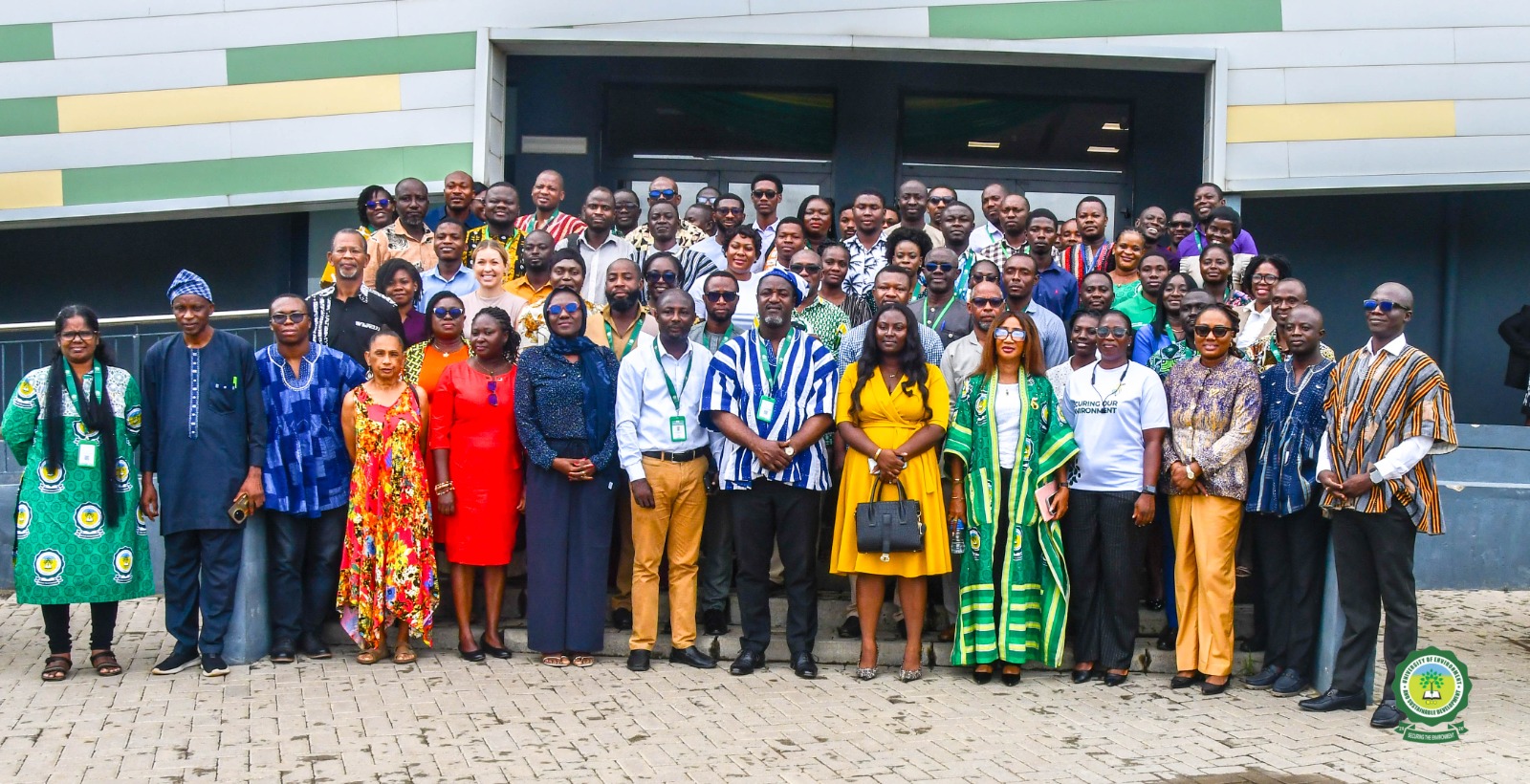
The University of Environment and Sustainable Development (UESD), Somanya, is spearheading national conversations on environmental contamination and sustainable agri-food systems as it hosts its 6th Sustainable Development Conference, which focuses on: “Environmental Contamination and Agri-Food Systems in Ghana: Threats and Opportunities from a Multi-Stakeholder Perspective.”
The three-day conference, which is being held alongside the maiden Agro-Food Systems Business Fair in partnership with the Nkabom Collaborative–UESD, brings together academics, policymakers, environmental experts, development partners, researchers, entrepreneurs, financial institutions, students and other stakeholders to examine the growing concerns surrounding environmental contamination and its implications for Ghana’s agri-food systems. The participants are from Ghana, including UESD staff and students, Nigeria, South Africa, the United Kingdom and the United States of America.
The programme features high-level policy dialogues, plenary and technical sessions, student presentations, exhibitions, business-to-business matchmaking and networking opportunities. Young entrepreneurs and innovators are also showcasing businesses and practical solutions across the agro-processing and aquaculture value chains, while the Nkabom Student Networking Day provides a platform for students to connect, collaborate and explore enterprise opportunities.
In his opening address, the Chairman of the Conference, Prof. Anthony Amoah, Dean of School of Sustainable Development, who spoke on behalf of the Vice-Chancellor, Prof. Eric Nyarko-Sampson, urged participants to actively engage in the discussions and activities lined up for the three-day event.
Prof. Amoah acknowledged the numerous environmental challenges confronting Ghana and called for a coordinated, multi-stakeholder approach to addressing environmental contamination and its impact on the country’s agri-food systems. He stressed the importance of collaboration among government, academia, industry, farmers, investors, and other stakeholders in protecting land and water resources, strengthening food security, and promoting sustainable agricultural practices. He further highlighted the opportunities presented by technology, innovation and investment, particularly in empowering young people and women to develop practical and sustainable solutions to environmental and agricultural challenges.
Prof. Amoah urged stakeholders to move beyond identifying environmental problems and focus on implementing measurable interventions that would restore degraded lands, protect water resources and contribute to building a resilient and economically prosperous agri-food system for Ghana.
Delivering the keynote address on behalf of the Chief Executive Officer of the Ghana Standards Authority (GSA), the Acting Director of Biomedical Sciences, Dr. Maxwell Kogbe, emphasised the critical role of standards in promoting sustainable development and ensuring the safety, quality and sustainability of Ghana’s agri-food systems.
He highlighted the need for stronger systems, regulations and practices to address environmental contamination and its implications for agriculture, food production and public wellbeing.
Dr. Kogbe further called for stronger collaboration among government institutions, academia, industry and other stakeholders to develop and implement innovative solutions to Ghana’s environmental and agricultural challenges. He noted that effective standards, research and technology could play a critical role in strengthening food systems, protecting the environment and contributing to sustainable economic development.
The first day also featured a number of technical presentations by scholars and researchers on issues relevant to the conference theme. Panel discussions explored critical issues including environmental contamination and agri-food systems, traceability, and standards enforcement. The discussions brought together experts from key institutions, including the Food and Drugs Authority (FDA), Ghana Standards Authority (GSA), A Rocha Ghana, Council for Scientific and Industrial Research (CSIR), and the Environmental Protection Agency (EPA), who shared diverse perspectives and valuable insights on the challenges and opportunities involved in safeguarding Ghana’s environment and food systems.