
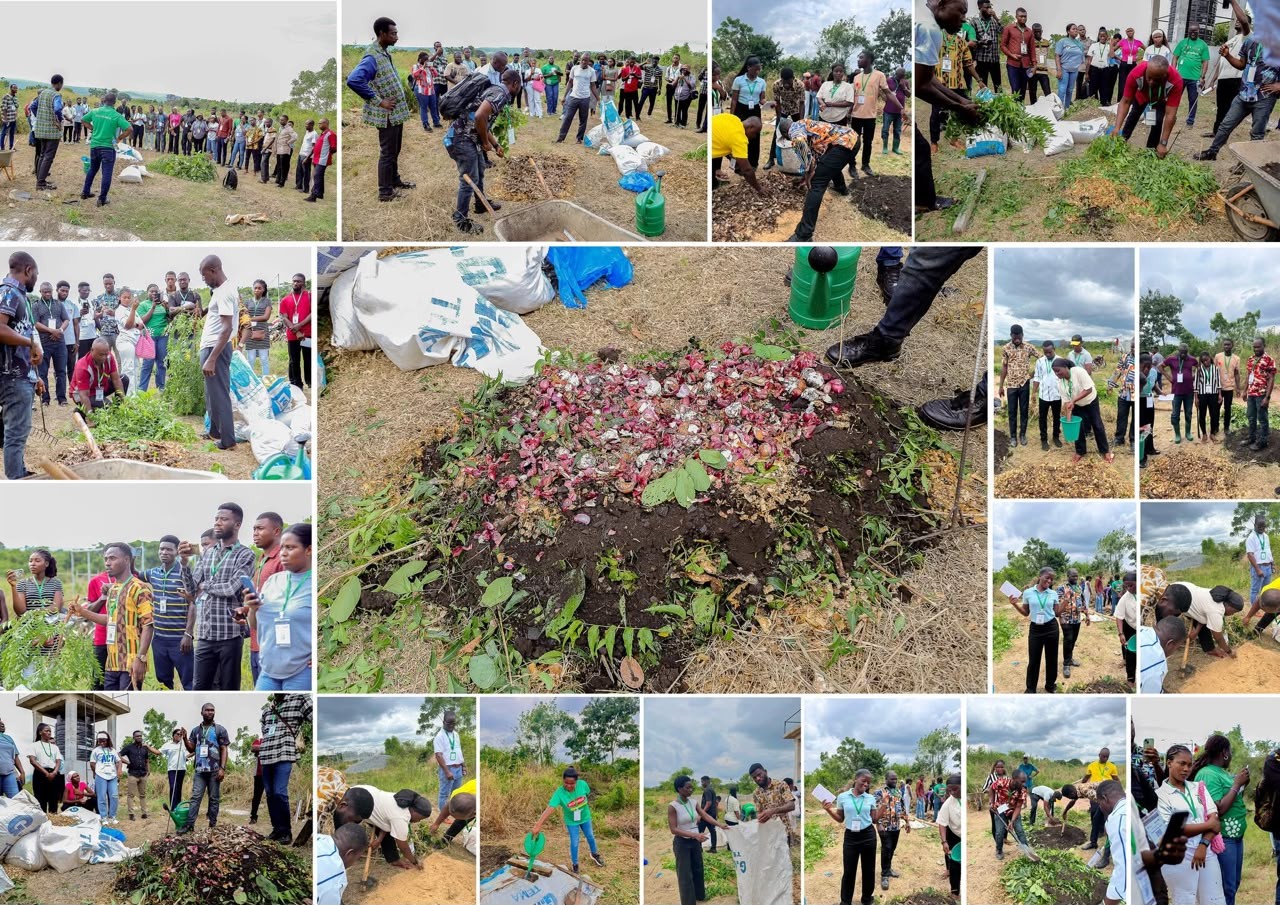
Agricultural waste is often treated as something to be cleared from farms, discarded or burned. But for participants in the Cohort 2 Practical Compost Production Training organised by the Nkabom Collaborative-UESD, agro-waste is taking on a new meaning-as a resource with the potential to produce useful agricultural inputs, support new businesses and create additional income opportunities.
The10-day training brought together 38 participants, comprising 27 males and 11 females, from diverse educational, agricultural and entrepreneurial backgrounds. Over the course of the programme, participants were introduced to soil health and organic matter, different types and nutrient content of agro-waste, composting methods and technologies, compost management and troubleshooting, legal and regulatory considerations, packaging and business development.
The programme combined classroom instruction with intensive hands-on practical sessions at UESD campus and Golden Exotics Limited, an agro-waste processing company at Asutuare in the Shai Osu Doku District, Greater Accra Region, where participants gained practical experience in converting agricultural waste into compost.
Participants constructed and managed compost piles using locally available agro-waste, learned how to layer “greens” and “browns”, monitored temperature and moisture, turned compost piles, identified problems, and assessed compost maturity. They also gained practical knowledge in bagging, storage, field application, and developing business ideas around compost production.
But the most significant outcome of the training may lie beyond the compost piles produced during the programme. Participants like Eugenia Oduma Amo, Romeo Kwablan-Tettey, Felix Teko and Nadra Haruna say the experience has opened new ways of thinking about waste, farming, enterprise and sustainable agriculture.
From Cocoa Pod Husks to a Growing Agro-Waste Enterprise:
An Industrial Engineering graduate of KNUST, Eugenia Oduma Amo is already exploring agricultural waste as part of her entrepreneurial journey. After completing her degree in 2024, Eugenia began exploring opportunities in the waste and agro-waste sector during her national service. Through her enterprise, Coco Potash, she sources discarded cocoa pod husks from farms and processes them into potash for use in black soap(locally known as alata semina) and fertiliser production.
The process, she explained, involves drying cocoa pod husks, burning them to produce ash, adding water and draining the liquid before heating it until it evaporates, leaving potassium salts.“I use agro-waste, specifically cocoa pod husk. I go to the cocoa farms and source the waste that the farmers do not need after they have their cocoa beans,” she explained.
Her interest in agro-waste was what drew her to the Nkabom compost training. Although compost production was the focus, she saw the programme as an opportunity to meet others working in related areas, exchange ideas and explore potential collaborations. That expectation was met. “My main reason for coming was to create connections and share ideas because I have like-minded people around me,” she said, adding that she had already identified a potential partner through the programme.
Eugenia notes that the training has also expanded her vision beyond her own enterprise. Living in a farming community, she now sees an opportunity to promote composting and encourage farmers to consider organic alternatives in their farming practices.
Turning Rabbit Waste into a New Revenue Stream
For Romeo Kwablan-Tettey, a rabbit farmer in Somanya, the training has changed the way he views one of the by-products of his farming enterprise. Romeo joined the programme looking for ways to create an additional income stream from his two-year-old rabbit farming business. Through the training, he discovered that the waste generated by his rabbits could itself become a useful agricultural product. “This compost training has helped me to understand that I can use their fecal matter, or their waste, to produce compost,” he said.
He now plans to collect and process rabbit waste into compost for sale, creating a potential second income stream from an existing farming activity. “Now I’m going to find ways to create compost out of their waste and then market it and sell it as well.”
The opportunity is significant for Romeo because it connects two activities within the same enterprise: rabbit production and compost production. His farm currently employs two people, and he hopes to create more employment as the business expands.
Romeo’s experience also highlights the value of the interconnected interventions offered through the Nkabom Collaborative. His participation in the compost production programme builds on an earlier E-Start training organised by UESD, where he gained knowledge in marketing and business development.
He said the lessons from that programme helped him improve the marketing of his rabbit business. After initially struggling to make sales, he began recording sales after applying the marketing knowledge he had acquired. His journey illustrates how different interventions can build on one another, helping participants strengthen existing businesses while identifying new opportunities within them. What was previously regarded simply as waste from his rabbit farm can now potentially become another product, another source of income and, as the enterprise grows, another avenue for employment.
Building Knowledge for Sustainable Farming
Felix Teko is a Master’s student with an interest in nutrition and agriculture; the compost training provided an opportunity to acquire practical skills that he hopes to apply in his own agricultural activities and eventually share with others.
The programme appealed to Felix because of its connection to agriculture and the use of organic materials in farming. “I believe it will help me acquire the necessary skills in composting so that, as I venture into agriculture, I can apply that knowledge,” he said.
During the training, Felix learned about different types and sources of organic waste and gained practical experience in constructing and managing a compost pile. He was introduced to the different stages of composting, temperature monitoring, turning the pile, and determining when the compost had reached maturity. His approach is deliberately modest and practical. Rather than attempting to establish a large operation immediately, Felix plans to begin on a small scale, using the skills acquired to produce compost for his own farming activities before considering expansion. “I’ll begin at a very small scale because it is going to require more manpower. I’ll begin from there to see how I can scale it up over time.”
He has already identified materials that are readily available in his community, including cassava peels, crop residues, and rice husks. “The main one will actually be cassava peels because it’s easily accessible and that is what the community around me is into. There is also rice production, so there is rice husk and all those things on the farms after the harvest.”For Felix, therefore, the value of the training lies in its practical application. The knowledge is not intended to remain in the classroom; it is knowledge he expects to take into his agricultural activities and eventually share with others.
Turning Maize Residues into a Farm Resource
Nadra Haruna, a Level 300 student of the University for Development Studies (UDS) and maize farmer, says the most immediate lesson from the training has been a new way of looking at the residues left on his farm. Nadra enrolled in the Nkabom Collaborative programme specifically to learn how to convert plant residues into compost. “I’m a maize farmer, and I enrolled in the Nkabom Collaborative programme to learn how to turn my plant residues into compost. So far, I’ve learned a lot, and I’m going to surely apply it on my farm.”
Previously, crop residues on his farm were either left behind or burned. Through the practical training, he learned how different organic materials—including “greens” and “browns”—can be combined and managed to produce compost.“On my farm, whenever I produce, I leave the crop residues or burn them. As of now, I know how to turn them into compost and the processes involved.”Haruna plans to apply the knowledge during the next planting season by converting residues already available on his farm into compost.
“I would not buy synthetic fertiliser, which is expensive. As I have the residues on the farm, I’ll surely turn them into something useful. “His experience captures one of the central possibilities demonstrated by the training: materials that are often regarded as waste can be brought back into the agricultural production cycle.
Instead of leaving or burning crop residues, farmers can learn to manage them and convert them into useful farm inputs. For farmers such as Haruna, this offers an opportunity to reduce waste, potentially lower input costs, and improve the use of resources already available on the farm.
Project Leadership Calls for Skills to Translate into Impact
At the closing ceremony, held at Lecture Theatre 2, participants were presented with certificates in recognition of their successful completion of the training. The Class Representative, Henry Hude, expressed appreciation to UESD and the Nkabom Collaborative for the opportunity to acquire practical knowledge and skills, noting that the training had enhanced participants’ understanding of compost production and its potential for creating sustainable livelihoods.
The Agro-Waste and Education Lead, Prof. Richard Amfo-Otu, said the programme strategically combined theoretical learning with practical field activities. He noted that participants revisited scientific concepts in chemistry, physics and biology and applied them directly to compost production.He encouraged the three groups that produced compost during the practical sessions to continue nurturing the piles until maturity, after which the compost could be packaged, documented and potentially used as part of the project’s pilot activities. He also indicated that plans were being considered for diploma and degree programmes in agrowaste, with composting forming part of the broader curriculum.
The Pro-Vice-Chancellor and Project Coordinator, Prof. Edward Wiafe Debrah, urged participants to regard the training as a beginning rather than an end. He said organic waste could provide an accessible raw material for business development, self-employment and job creation, and assured participants that the project would continue to monitor their progress and provide further support where necessary.
The Vice-Chancellor and Project Investigator, Prof. Eric Nyarko-Sampson, encouraged participants to put their knowledge into practice, work collaboratively and explore cooperative ventures. He also stressed the need for greater participation of young people from Somanya so that the local community could benefit more directly from the opportunities created by the project. Present were the the Project Administrator and Registrar of the University, Mrs Mary Abena Agyepong.
Resource persons for the training were Dr. Samuel Joe Acquah, Dr. Ishael Lente, Dr. Gifty Kumi-Amoah, Dr. Lloyd Larbi, and Dr. Stella Nyarko.