
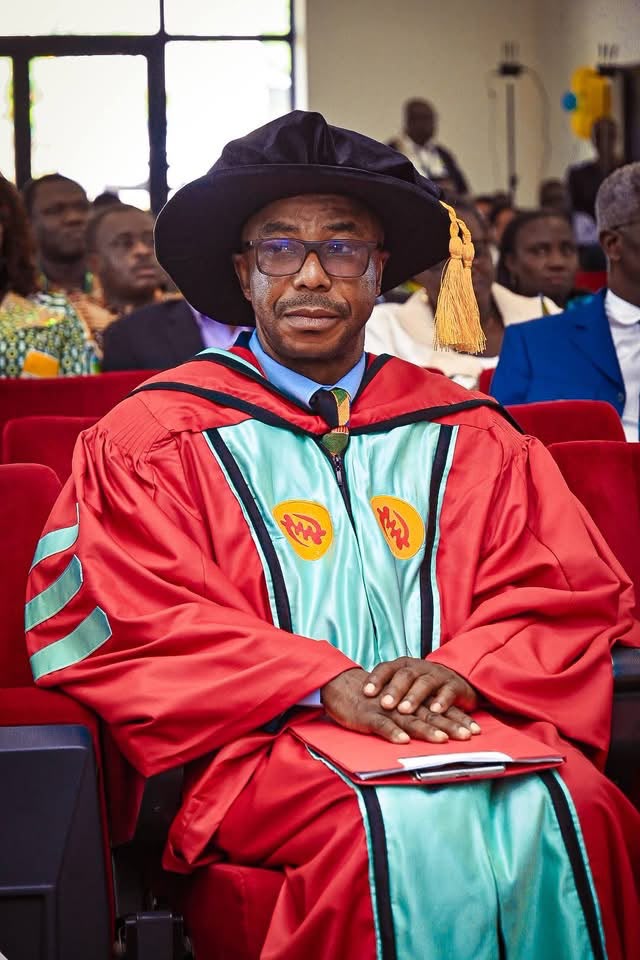
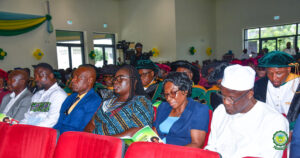
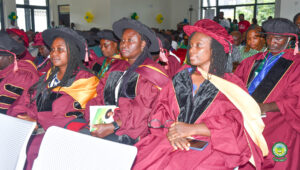
The Auditorium, Multipurpose Building at the University of Environment and Sustainable Development (UESD) was overflowing with academics, members of the University community, government officials, traditional authorities, development partners, students, family, friends, and other distinguished guests who gathered for the Professorial Inaugural Lecture of the Pro Vice-Chancellor, Professor Edward Wiafe Debrah, a renowned Conservation Biologist.
Delivered under the theme, “Biodiversity at the Crossroads: Science, Conservation and Sustainable Development in Africa,” the lecture provided a platform for stakeholders to reflect on the urgent need to protect Africa’s rich biodiversity and its indispensable role in achieving sustainable development.
“Biodiversity at the Crossroads: Science, Conservation and Sustainable Development in Africa.” The Lecture was moderated by the Registrar, Mrs Mary Abena Agyepong.
In a thought-provoking presentation grounded in over three decades of research, professional practice, and leadership in conservation science, Professor Wiafe Debrah highlighted the growing threats facing Africa’s biodiversity, including habitat destruction, climate change, illegal mining, deforestation, pollution, land degradation, and unsustainable resource exploitation.
He emphasised that biodiversity is not merely an environmental concern but a strategic development asset that underpins food security, water security, climate resilience, public health, livelihoods, tourism, and economic growth.
“Biodiversity is not a luxury. It is the foundation of sustainable development. When biodiversity declines, development itself becomes more fragile,” Professor Wiafe Debrah stated. The inaugural lecture examined the central question that has guided much of his scholarly career: “How can development proceed without destroying the ecological systems that sustain life?”
Drawing on extensive research in primate conservation, wildlife management, forest ecology, human-wildlife conflict, environmental governance, ecosystem restoration, and community-based conservation, Professor Wiafe Debrah demonstrated how scientific evidence can inform practical solutions to contemporary environmental challenges.
A significant portion of the lecture highlighted his internationally recognised work on endangered primates of the Upper Guinea Forest ecosystem, including the critically endangered Roloway Monkey, Lowe’s Monkey, White-thighed Colobus, and Olive Colobus. His contributions have informed conservation policies, IUCN Red List assessments, protected area management, and international species recovery initiatives.
Professor Wiafe Debrah further stressed that conservation efforts must extend beyond law enforcement and protected areas. He advocated for integrated approaches that combine scientific research, community participation, sustainable livelihoods, environmental education, and responsible governance. According to him, local communities must be seen as partners and beneficiaries of conservation rather than passive observers.
“Conservation succeeds when science informs action, when communities are partners, and when future generations remain at the centre of our decisions.”
The lecture also showcased the Conservation Biologist. contributions to environmental impact assessment, biodiversity management planning, ecosystem restoration, climate adaptation research, and international conservation policy development. His work has influenced conservation practice not only in Ghana but across Africa and globally.
The Vice-Chancellor of UESD, Prof. Eric Nyarko-Sampson, commended Professor Wiafe Debrah for his distinguished career in scholarship, conservation practice, mentorship, and University leadership, describing him as a scholar whose work exemplifies the University’s commitment to environmental sustainability and societal transformation.
He described Professor Wiafe Debrah as a scholar whose impact reaches beyond academia, highlighting his significant contributions to environmental impact assessments, biodiversity conservation, management planning, safeguard advisory services, and global conservation efforts.
‘His involvement in global conservation assessments and collaborations reflects the international recognition of his expertise,’ he added
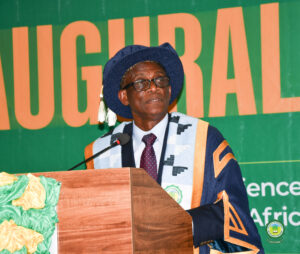
In his remarks, the UESD Council Chairman, Hon. Seth Emmanuel Terkper In his brief remarks, the Chairman of the Governing Council, Mr. Emmanuel Seth Terkper, expressed the hope that Prof. Wiafe Debrah’s work would continue to enhance the University’s visibility and impact. He also noted that photographs and videos from the forest fieldworks, as depicted in the presentation, evoked nostalgic feelings, reminding him of his youthful visits to his grandfather’s farm during long vacations. He praised the work as inspiring and valuable to the University’s mandate.
The lecture concluded with a call for collective action among governments, Universities, communities, Civil Society Organizations, development partners, and the private sector to safeguard biodiversity as a foundation for sustainable development.
About Professor Edward Wiafe Debrah
Professor Edward Wiafe Debrah is a distinguished conservation scientist, primatologist, environmental manager, and academic leader. He currently serves as the Pro Vice-Chancellor of the UESD. With more than thirty years of experience in forestry, wildlife conservation, environmental governance, research, consultancy, and higher education, he is widely recognised as one of Ghana’s leading authorities in biodiversity conservation and sustainable development.
His research interests include biodiversity conservation, primatology, forest management, wildlife ecology, human-wildlife conflict, ecosystem services, environmental governance, and sustainable development. He has authored numerous scholarly publications and contributed to international conservation initiatives, including IUCN Red List assessments and global primate conservation action plans.
About UESD
The University of Environment and Sustainable Development (UESD) is Ghana’s premier Public University dedicated to environment and sustainable development. Established to advance teaching, research, innovation, and community engagement, UESD seeks to produce environmentally conscious leaders and solutions that contribute to sustainable national and global development.