
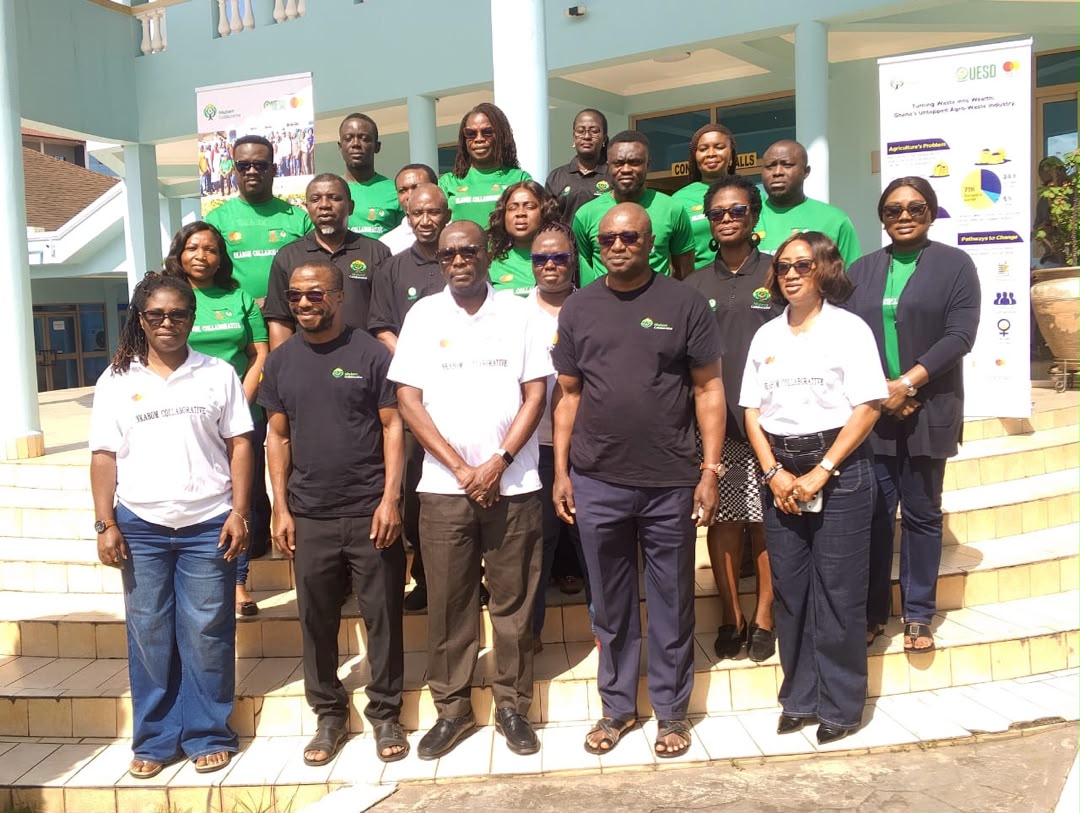
The Nkabom Collaborative-UESD is shifting its focus from training young people to ensuring that they transition into employment, self-employment and sustainable enterprises, with a Year Three target of training 500 young people and supporting at least 200 into work. The Project Investigator (PI) and Vice-Chancellor of UESD, Prof. Nyarko-Sampson, said the target should serve as one of the project’s central measures of success, stressing that achieving it would require more than training.
“This is not primarily a training question. It is a pathway question,” he said, highlighting the need for mentorship, incubation, job matching, industry partnerships, access to finance and markets, as well as continuous monitoring.
The target formed the centre of discussions on the final day of a three-day retreat held to review the implementation of Year Two and prepare the project for Year Three. The retreat ended with members adopting the Year Two close-out matrix and the Year Three roadmap, setting out priorities and implementation directions for the next phase of the project.
Addressing the project team on the final day, the Project Investigator and Vice-Chancellor of the University of Environment and Sustainable Development (UESD), Prof. Eric Nyarko-Sampson, said the success of Year Three should no longer be measured primarily by the number of people trained, courses delivered or certificates issued. He said the more important question was what happened to beneficiaries after training. “Do our beneficiaries secure employment? Do they establish businesses? Do existing enterprises grow? Do they create additional jobs? Do their incomes improve? And are these opportunities sustainable?” he asked.
Prof. Nyarko-Sampson said Year Three would therefore seek to establish a more strategic pathway linking training to mentorship, practical experience, incubation or job matching, employment or enterprise and, ultimately, sustainable livelihoods. He explained that the different components should function as one connected support system rather than as separate interventions. Under the new approach, mentorship is expected to provide beneficiaries with practical guidance beyond the classroom, including support to refine business ideas, understand markets, improve business practices and make informed career decisions.
The PI said mentorship should, however, be judged by what changes it produces for beneficiaries and not merely by the number of mentors engaged or meetings organised.
He also called for emphasis on enterprise incubation, saying the project must move beyond entrepreneurship training to helping young people establish and grow viable businesses.He said the UESD Entrepreneurship and Innovation Hub should provide practical support in areas such as business planning, financial management, product development, quality assurance, branding, marketing, regulatory compliance, access to finance and markets.
Prof. Nyarko-Sampson noted that not every beneficiary would become an entrepreneur and said employment, internships and apprenticeships must therefore form an equally important part of the pathway. He identified the Inclusive Job Matching Platform as a critical mechanism for connecting trained young people with employers, internship and apprenticeship opportunities, mentors and enterprise support. The platform, he said, should become a functional link between skills and opportunity rather than simply a database of trained beneficiaries.
The Vice-Chancellor further stressed that support for young enterprises should continue after incubation, particularly through access to finance, markets and value chains. He called for stronger partnerships with industry, saying companies should be involved not only at the point of recruitment but throughout the process, including training design, mentorship, internships, identification of skills gaps, product validation and market access.
He also cautioned that inclusion must extend beyond recruitment and participation in training. Women, persons with disabilities, rural youth and other underserved groups, he said, must be supported throughout the pathway-from training and mentorship to internships, incubation, finance, employment and enterprise growth.To determine whether the new approach is producing results, Prof. Nyarko-Sampson called for stronger post-training monitoring and tracer studies at six, 12 and 24 months.
The project, he said, should be able to track where beneficiaries started, the training and support they received, where they are after training and what has changed in their lives.
At the closing ceremony, the Project Administrator and Registrar of UESD, Mrs Mary Abena Agyepong, who presided over it, urged members of the project team to recommit themselves to the vision of the Nkabom Collaborative and its goal of creating dignified opportunities for young people, marginalised and displaced persons. She reminded the team that Nkabom is a 10-year project whose impact should extend beyond Somanya and its immediate surroundings.
Mrs Agyepong urged members to see themselves as “architects of legacy” for young people, displaced and marginalised communities, and called for the Somanya township and surrounding communities to become part of the project’s success story.
The Project Coordinator and overall moderator of the retreat, Prof. Edward Wiafe Debrah said Year 3 would focus on moving beneficiaries into the world of work through internships, mentorship and stronger connections with industry. He said the project would also create opportunities for beneficiaries to access markets for their products while extending training to other deprived and underserved communities. The next phase, he explained, would therefore not end with equipping beneficiaries with knowledge and skills but would follow them through the transition into the world of work and support them towards sustainable livelihoods.