
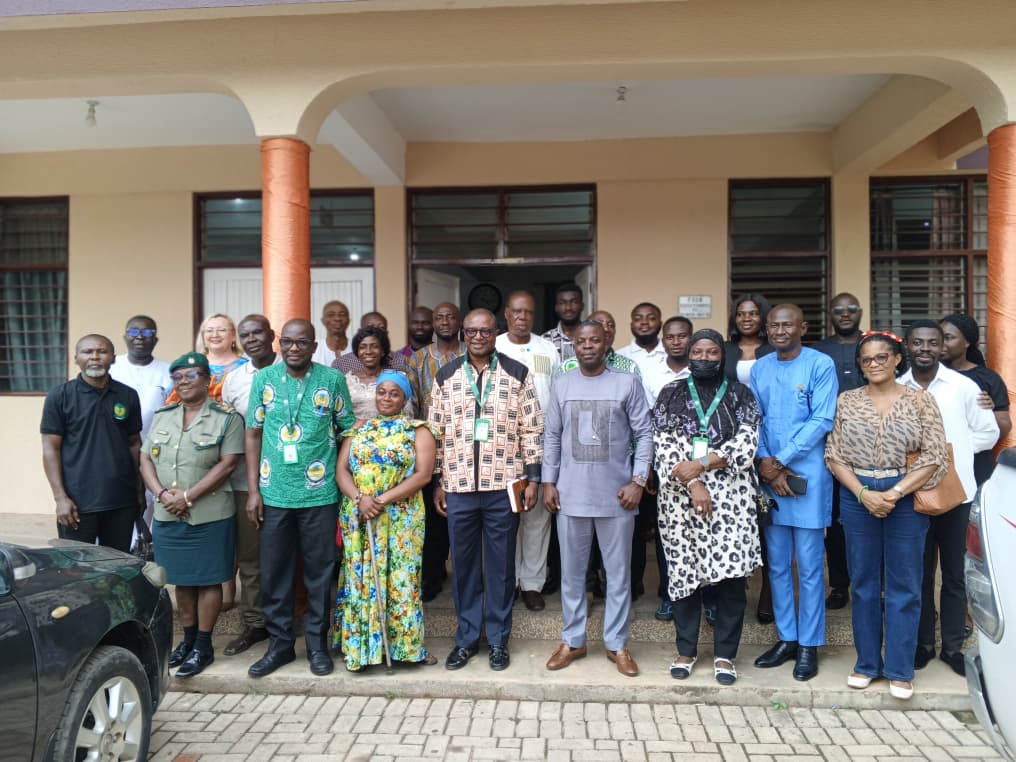
In line with its commitment to enhance community participation in environmental restoration initiatives, strengthen the partnership between the University of Environment and Sustainable Development (UESD) and the Yilo Krobo Municipal Assembly, and provide students with practical academic exposure, postgraduate students of UESD have made a presentation on “Principles of Sustainable Development and Their Application in Somanya” to staff members at the Yilo Krobo Municipal Assembly Hall.
The engagement formed part of the University’s commitment to community-based learning and knowledge exchange, providing a platform for students to share research-based perspectives while contributing to discussions on environmental restoration and sustainable development within the municipality.
The Dean of the School of Natural and Environmental Sciences (SNES), Prof. Shine Francis Gbedemah, and the Vice-Chancellor of UESD, Prof. Eric Nyark-Sampson, and other faculty members accompanied the students to the engagement.
Prof. Gbedemah explained that the engagement was designed to bridge the gap between academic learning and practical community development. The initiative also seeks to strengthen the University’s partnership with the Yilo Krobo Municipal Assembly in advancing environmental restoration and sustainable development within the municipality.
The presentation was led by Mr. Maxwell Boakye, also the first Valedictorian of UESD. He highlighted key principles of sustainable development and demonstrated how they can be applied to address environmental challenges facing the Yilo Krobo Municipality.
Mr. Boakye discussed fundamental sustainable development principles, including the holistic approach to development, intergenerational and intragenerational equity, environmental protection, public participation and good governance, the precautionary principle, and the polluter pays principle. He explained how these principles can guide policy decisions and community actions towards sustainable environmental management and long-term socio-economic development.
The presentation stimulated insightful discussions among participants, during which Assembly officials outlined ongoing interventions to address environmental challenges within the Municipality. While acknowledging financial constraints, they reaffirmed the Assembly’s commitment to implementing practical measures aimed at promoting environmental sustainability and improving the well-being of residents.
In his remarks, Prof. Nyarko-Sampson expressed appreciation for the strong and growing partnership between UESD and the Yilo Krobo Municipal Assembly, particularly for creating opportunities for students to engage directly with policymakers and development practitioners.
He emphasised the importance of integrating aspects of the University’s academic curriculum into the activities of the Municipal Assembly, noting that such collaboration would enable research and academic expertise to respond directly to local development needs. He explained that this approach would allow the University to provide practical, evidence-based solutions through its teaching, research, and community engagement initiatives.
The Vice-Chancellor further reaffirmed the University’s commitment to supporting the Assembly’s development agenda. He highlighted the Nkabom Collaborative Project, a partnership involving eight Universities-including UESD and McGill University, Canada-the Association of Ghana Industries (AGI), and other stakeholders, with support from the Mastercard Foundation. He explained that the project seeks to create decent and fulfilling employment opportunities for approximately 55,000 young people, particularly women and vulnerable groups, across Ghana.
Prof. Nyarko-Sampson noted that the Yilo Krobo Municipal Assembly has a critical role to play in the successful implementation of the project and reaffirmed the University’s readiness to work closely with the Assembly to advance shared sustainable development goals.
The Municipal Chief Executive (MCE) for Yilo Krobo, Hon. Francis Addo Akumatey, thanked the University delegation for the engagement and affirmed that UESD has become an important partner in the development of the municipality.
He called on stakeholders to support the University in fulfilling its mandate and acknowledged the financial challenges confronting some of the Assembly’s operations. He assured participants that his administration remains committed to addressing environmental challenges and implementing initiatives that will promote sustainable development and improve the quality of life of residents.
The engagement reinforced UESD’s commitment to applying academic knowledge to real-world challenges while strengthening collaboration with local government and communities to advance environmental restoration and sustainable development.