
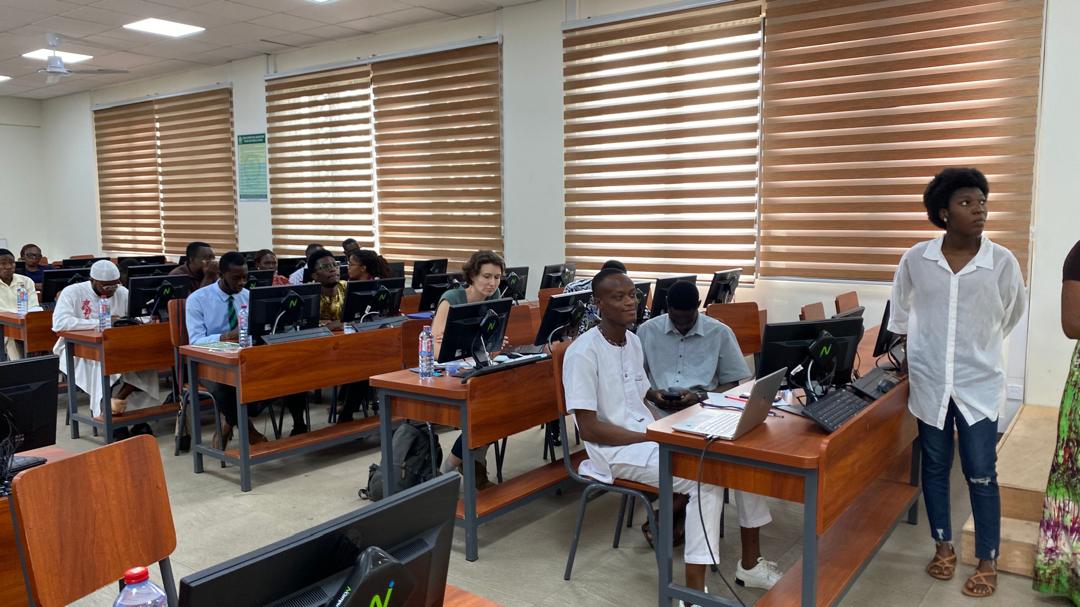
The five-day course on: “Feeding the Future: Food Security, Sustainability and Smart Agri-Food Systems,” held at the University of Environment and Sustainable Development (UESD), Somanya in the Eastern Region, has ended with a call on participants to lead the future of sustainable food systems.
The five-day course was funded by the European Union’s Erasmus+ Programme under the Staff Mobility for Teaching framework, which supports the international mobility of visiting academic staff. The initiative forms part of the internationalisation and modernisation strategies of the partner Universities and reflects their shared commitment to global academic collaboration.
The training was facilitated by Dr. Eefje Aamoudsa from the Bonn-Rhein-Sieg University of Applied Sciences in Germany, with support from Mona Lisa Marembe.
Delivering the closing remarks, the Pro Vice-Chancellor, Prof. Edward Wiafe Debrah, underscored the growing global challenges of climate change, environmental degradation, rapid population growth, and increasing pressure on natural resources. He emphasised that food security is not only a scientific concern but also a moral responsibility. The training exposed participants to critical areas including sustainable agricultural practices, food system resilience, innovation, and environmental stewardship.
Prof. Wiafe Debrah urged the participants to see themselves as future leaders and change-makers, noting that the knowledge acquired would empower them to contribute meaningfully across diverse sectors such as research, policy, agribusiness, environmental management, and community development. He stressed that the future of food depends not merely on producing more but on producing smarter- conserving resources, protecting biodiversity, and ensuring equity and sustainability. “The future of food security depends on leaders like you,” he stated, encouraging participants to move forward with confidence, purpose, and determination to help feed the future sustainably.
He congratulated the participants on their dedication and active engagement throughout the programme and commended the facilitators for their commitment during the training.
The highlight of the programme was the presentation of certificates to participants, who included faculty members, Civil Society Organisations, students, and other stakeholders.
The training, among other outcomes, equipped participants with practical tools to measure, analyse, and evaluate food security indicators and policies, bridge academic learning with real-world programmes, and prepare for careers in research, development agencies, government, NGOs, agribusiness, and sustainability consulting.