
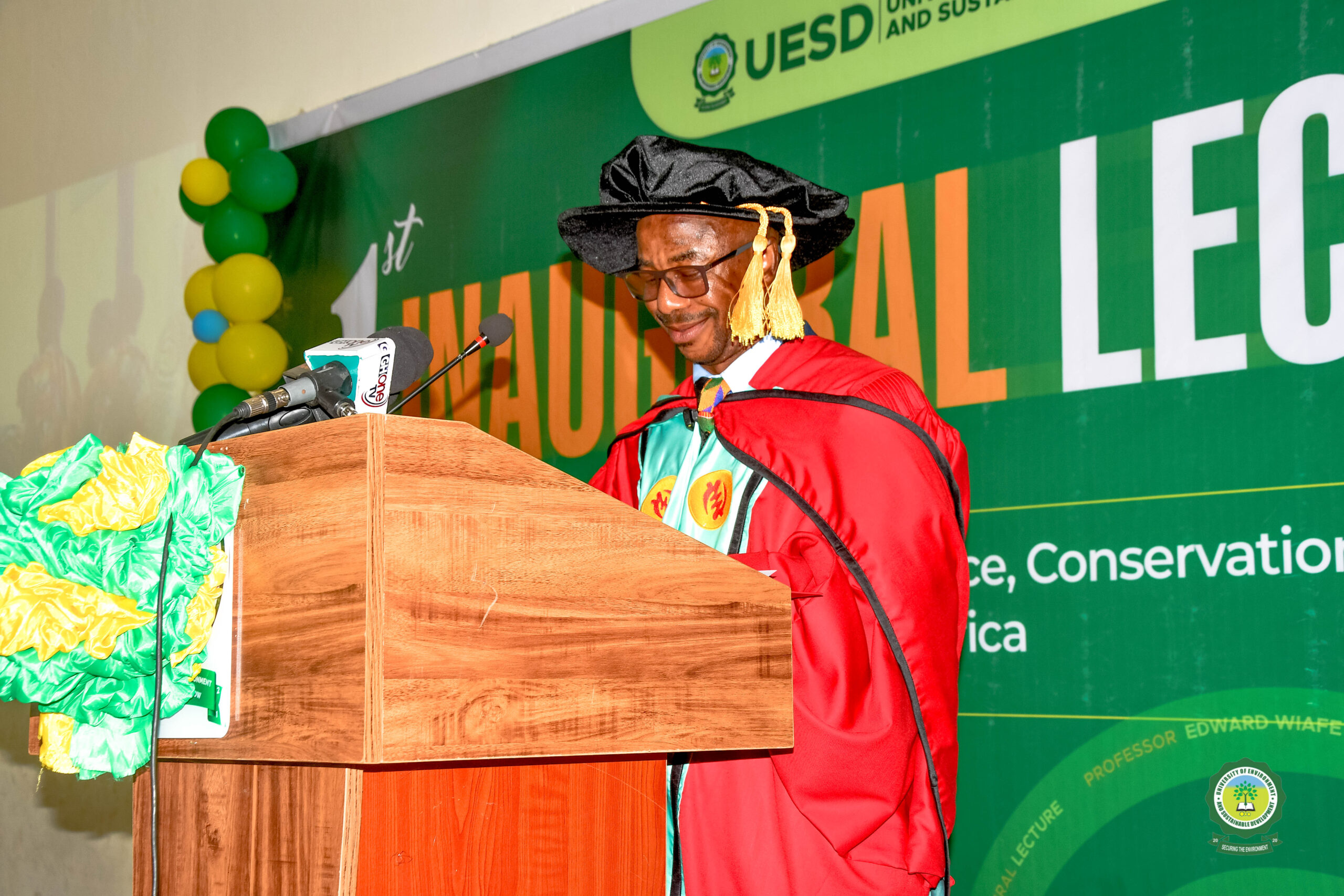
At his inaugural lecture, held on 2nd July 2026, at the Auditorium, Multipurpose-Building, Prof. Edward Wiafe Debrah presented a compelling vision for advancing sustainable development through biodiversity conservation. Drawing on more than three decades of research, teaching, and professional practice, Prof. Wiafe Debrah, a Conservation Biologist and Pro Vice-Chancellor of UESD, highlighted the indispensable role of biodiversity in promoting human well-being, economic growth, and environmental resilience. Structured under nine (9) thematic headings, the lecture emphasised the importance of science-driven policies, community-centred conservation, and multi-stakeholder collaboration in addressing Africa’s pressing environmental challenges. Below are some of the key insights and takeaways from his lecture.
Biodiversity is the Foundation of Sustainable Development Professor Wiafe Debrah emphasised that biodiversity should not be viewed merely as wildlife or forests, but as Africa’s natural capital that underpins food security, clean water, climate resilience, healthcare, tourism, livelihoods, and economic growth. He stressed that protecting biodiversity is essential for sustainable development and the well-being of present and future generations.
Africa Faces a Defining Environmental Crossroads; He observed that although Africa possesses abundant natural resources and immense human potential, it is simultaneously confronted by deforestation, biodiversity loss, illegal mining, land degradation, pollution, climate change, food insecurity and widening social inequalities. He noted that the choices made today will determine whether future generations inherit resilient ecosystems or environmental decline.
Development Must Not Destroy Nature: Reflecting on more than three decades of research and professional experience, Professor Wiafe Debrah posed the central question that has guided his academic career:“How can development proceed without destroying the ecological systems that sustain life?” He argued that economic development and environmental conservation must be pursued together rather than seen as competing priorities.
Science Must Inform Conservation –The Conservation Biologist underscored the importance of scientific research in shaping biodiversity conservation policies. Drawing from his work on endangered primates, protected areas, ecosystem restoration and biodiversity monitoring, he highlighted that evidence-based research remains indispensable for effective conservation planning and environmental governance.
Conservation Requires Communities, Not Enforcement Alone-Professor Wiafe Debrah stressed that biodiversity conservation cannot succeed through law enforcement alone. Instead, it must be grounded in community participation, adaptive management, social justice, and sustainable livelihood opportunities. According to him, local communities should be regarded as partners whose welfare is directly linked to successful conservation outcomes.
Wildlife Conservation Supports Human Prosperity-Sharing insights from his research across Ghana and West Africa, Professor Wiafe Debrah explained that conserving wildlife also safeguards forests, water resources, agriculture, climate stability, and human livelihoods. He noted that the survival of species such as the Roloway Monkey and White-thighed Colobus reflects the overall health of ecosystems upon which society depends.

Conservation Must Be Adaptive and Evidence-Based-Drawing from his experience at Kakum National Park, Prof. Wiafe Debrah advocated adaptive conservation management supported by reliable ecological data. He explained that ranger patrols should not only enforce laws but also generate scientific information that guides conservation decisions and improves protected area management.
Human-Wildlife Coexistence is Essential-His lecture highlighted that successful conservation depends on reducing conflicts between wildlife and neighbouring communities. Professor Wiafe Debrah cited research demonstrating that practical, locally driven solutions can reduce crop destruction while protecting wildlife, thereby promoting peaceful coexistence between people and nature.
Biodiversity Conservation is a Development Imperative-He emphasised that biodiversity conservation should not be viewed as an environmental issue alone but as a development necessity. He called for stronger collaboration among governments, universities, policymakers, communities, and development partners to ensure that Africa’s economic growth is achieved alongside environmental sustainability.
A Call to Collective Action-Prof. Wiafe Debrah ended his lecture with a powerful appeal, urging governments, researchers, students, communities, and citizens to embrace evidence-based policies, interdisciplinary research, and responsible environmental stewardship in safeguarding biodiversity for future generations.
“Conservation succeeds when science informs action, when communities are partners, and when future generations remain at the centre of our decisions.”
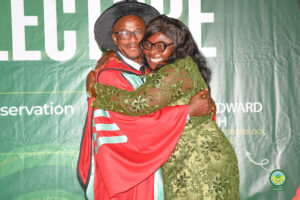
Professor Edward Wiafe Debrah took time to acknowledge the many individuals who have influenced his personal and professional journey. He paid heartfelt tribute to his family, friends, colleagues, collaborators, teachers, mentors, and students, expressing profound gratitude for their unwavering support, guidance, encouragement, and contributions to his success over the years.