
The Office of the Dean of Students’ Affairs at the University of Environment and Sustainable Development (UESD), Somanya, Eastern Region in collaboration with the Youth Climate Council Ghana and the Youth Bridge Foundation, has organised a training on Ghana’s National Adaptation Plan (NAP). The programme was held under the theme: “From Policy to Action: Advancing Ghana’s National Adaptation Plan (NAP) through University Youth Engagement.”
It aimed to deepen students’ understanding of Ghana’s climate adaptation agenda and empower young people to actively contribute to national and community-level climate resilience efforts. The programme was held under the theme: “From Policy to Action: Advancing Ghana’s National Adaptation Plan (NAP) through University Youth Engagement.”
Ghana’s National Adaptation Plan (NAP) is a national strategy designed to address the impacts of climate change and strengthen resilience across sectors. Developed by the Environmental Protection Agency under the Ministry of Environment, Science, and Technology, NAP aligns with global frameworks such as the Paris Agreement and the Cancun Adaptation Framework. The plan is supported by the Green Climate Fund and the United Nations Environment Programme.

In her remarks, the Dean of Students’ Affairs, Prof. Daniella Sedegah, emphasised the critical role of University students in translating climate policy into practical action. She noted that while frameworks like the NAP provide direction, their success depends largely on the active participation of young people.
Prof. Sedegah encouraged students to see themselves as innovators and change agents, capable of driving sustainable solutions within their communities. She further highlighted the importance of interdisciplinary collaboration, research, and advocacy in addressing climate challenges, urging students to take advantage of opportunities within the university to build relevant skills and contribute meaningfully to national development.
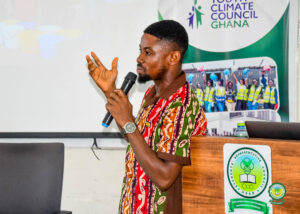
The training featured a presentation by climate adaptation professional, Mr. Sarfoh Danquah, who provided an overview of the NAP, Ghana’s climate risks, and the role of youth in advancing adaptation efforts. Drawing from personal experiences, Mr. Danquah illustrated how climate change impacts everyday life, particularly through water scarcity, rising temperatures, and food insecurity. He explained the evolution of global climate action under the United Nations Framework Convention on Climate Change and highlighted the importance of both mitigation and adaptation strategies.
Mr. Danquah also underscored the importance of youth engagement, innovation, and knowledge-building, urging students to leverage their skills, research, and creativity to develop practical climate solutions.
A panel discussion was held to explore practical, youth-centered approaches to implementing Ghana’s National Adaptation Plan (NAP), particularly in the areas of agriculture, urban resilience, and climate communication.
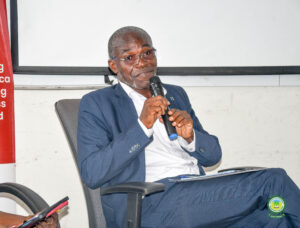
The panel featured: Dr. Prize F. Y. McApreko -Vice Dean, Ghana Armed Forces Command and Staff College and former Head of Department of at UESD. Mr. Sarfoh Danquah, and Ms. Mawena Azuma – Communications Lead, Youth Bridge Foundation
The discussion highlighted the importance of translating climate policy into practical, community-level action through youth engagement.
Ms. Azuma emphasised that climate change must be communicated in relatable and accessible ways. Drawing from field experiences, she noted that many communities experience climate impacts, uch as water scarcity and coastal erosion—without fully understanding them as climate issues. She encouraged students to use digital tools and social media platforms to simplify climate messages, raise awareness, and inspire action.
Dr. McApreko focused on mindset and capacity building, urging students to overcome self-doubt and actively position themselves within the climate space. He highlighted research as a key entry point, encouraging students to align their academic work with climate challenges across sectors such as water, agriculture, and infrastructure. He stressed that climate change presents opportunities for innovation, leadership, and career development.
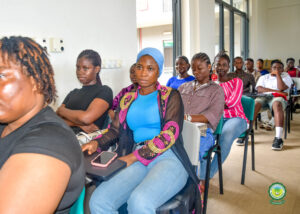
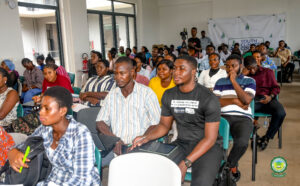
Collectively, the panelists underscored the need for youth to take initiative, build relevant skills, and leverage both traditional knowledge and modern innovation to contribute meaningfully to climate adaptation efforts. Participants engaged in an interactive breakout session designed to translate knowledge into practical solutions. It provided an opportunity for students to respond to a critical question: What is the Ghanaian youth bringing on board in terms of innovation and also to reflect on lessons from the training and collaboratively develop practical, solution-oriented ideas.