
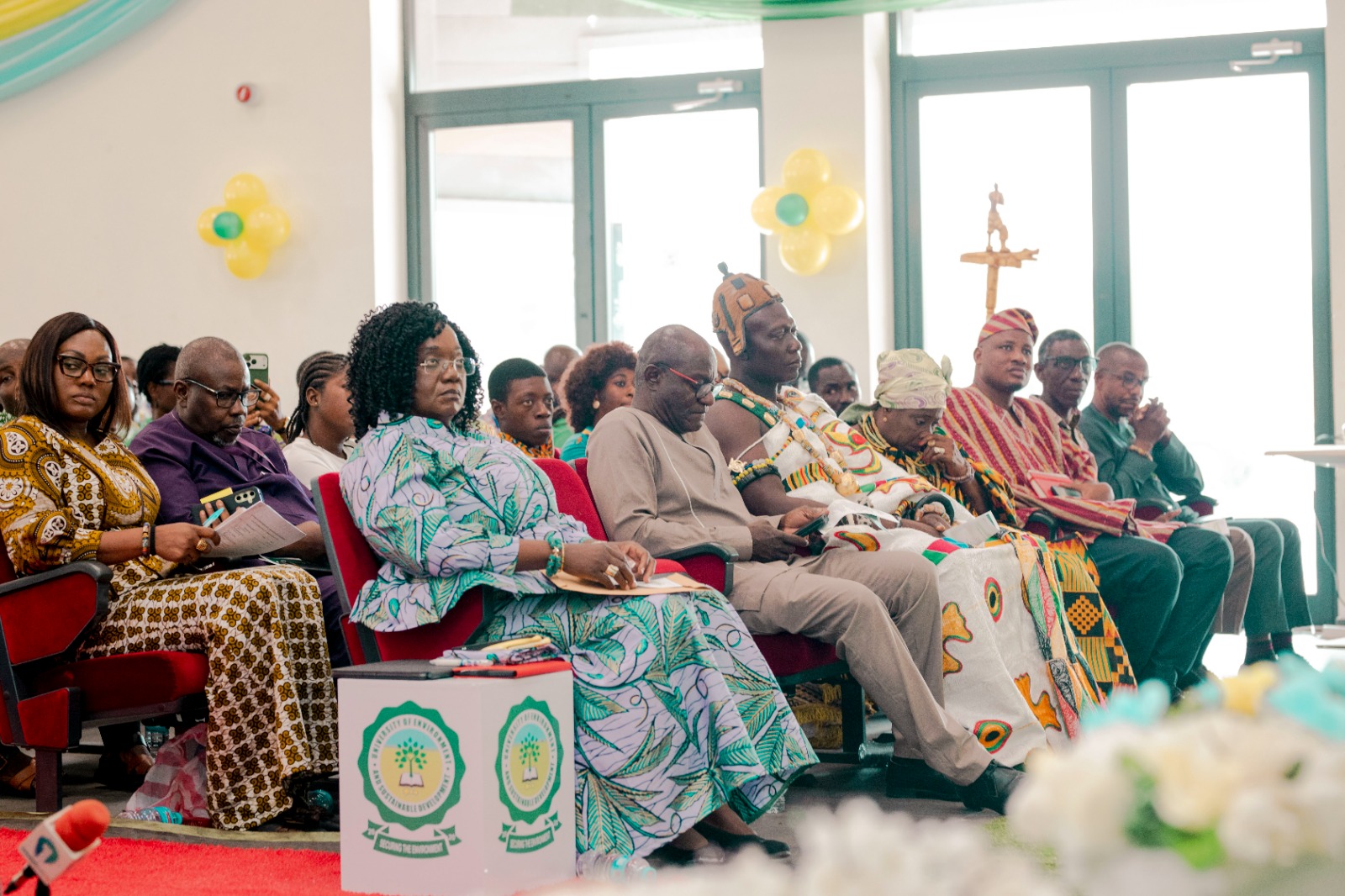
Panellists at the 6th Commencement Lecture of the University of Environment and Sustainable Development (UESD), Somanya, in the Eastern Region, have reiterated that illegal mining, popularly known as galamsey, remains one of Ghana’s most pressing national challenges and requires sustained, coordinated, and evidence-based interventions to address. They say, Ghana’s ability to make meaningful progress in the fight against galamsey hinges on the strict enforcement of existing laws and regulations, reinforced by strong political will, transparency, and accountability at all levels of governance.
They further emphasised the critical role of research in confronting the menace, calling for increased investment in universities and research institutions to generate data-driven and context-specific solutions. The panelists noted that scientific evidence must guide national policy decisions, particularly in protecting water resources, forest reserves, and vulnerable communities that continue to bear the brunt of illegal mining activities.
The panel discussion followed a keynote presentation on the topic: on: Securing the Environment Challenging the Galamsey Menace in Ghana, delivered by Prof. Gibrilla Abass, a Water Resources Scientist and Isotope Hydrologist and faculty member of UESD It which was attended by a cross-section of participants, including members of the University community, public officials, Civil Society Organisations, and invited guests. The panel was made up of distinguished professionals and practitioners with diverse expertise in environmental management, governance, and policy. These included, Hon. Nana Adu Sarpong Addo-Aikins, Municipal Chief Executive for Abuakwa South; Dr. Mathew Inkoom, a faculty member of UESD of the Department of the Built Environment; Mr. Daryl Bosu, Country Director of A Rocha Ghana; and Mr. Solomon Otoo, representing the Environmental Protection Agency (EPA).

It was moderated by Dr. Rahmat Quaigrane Duker of the School of Natural and Environmental Sciences, which featured a robust and thought-provoking exchange among panelists.The discussion ensured a balanced and insightful examination of the environmental impacts of galamsey, associated governance and enforcement challenges, and sustainable pathways for addressing the problem.
The panel examined the multidimensional nature of galamsey and its far-reaching consequences for water bodies, forest reserves, livelihoods, and public health. Panelists observed that despite the existence of regulatory and legal frameworks, the continued degradation of Ghana’s natural resources points to significant gaps in enforcement, limited public awareness, and weak coordination among key stakeholders. They stressed the need for improved inter-agency collaboration and sustained public education to influence attitudes and behavioural change toward illegal mining.
In addition, the discussion highlighted the importance of community engagement and the active involvement of traditional authorities, whose leadership and influence at the local level were identified as crucial in strengthening enforcement and promoting compliance. Panelists noted that empowering communities with alternative livelihoods and involving them in environmental decision-making could help reduce dependence on illegal mining and foster long-term sustainability.
Earlier in his keynote address, Prof. Gibrilla Abass warned that illegal mining poses an existential threat to Ghana’s water resources and, by extension, the country’s long-term survival. Drawing on peer-reviewed scientific research and nearly two decades of professional experience in the water sector, He recounted the progression of mining in Ghana from the pre-colonial era, when artisanal and small-scale mining existed in relatively sustainable forms, to its current state as a highly organised and syndicated activity involving heavy machinery and powerful local and foreign interests.
Prof. Abass presented research findings on major rivers, including the Birim, Pra, Offin, Ayensu, Tano, and Bonsa, revealing turbidity levels ranging from 9 to as high as 16,800 NTU, far exceeding the World Health Organization’s guideline value of 5 NTU for drinking water. He disclosed that dissolved oxygen levels in several rivers had dropped to hypoxic or near-lethal levels, rendering them unsuitable for aquatic life, while Water Quality Index assessments classified many river stretches as poor or grossly polluted.
He further revealed that more than 60 percent of Ghana’s water bodies are contaminated with toxic chemicals such as mercury, cyanide, arsenic, and lead, largely due to illegal mining activities. These pollutants, he explained, have rendered many rivers unsafe for human consumption and compelled the Ghana Water Company Limited to shut down some treatment plants because of extremely high turbidity levels.
Beyond water quality, Prof. Abass highlighted the broader environmental and public health implications of galamsey, including land degradation, loss of biodiversity, food insecurity, and increased health risks for mining communities. He attributed the failure of previous government interventions to political interference, corruption, weak enforcement of environmental laws, inadequate regulation, the influx of foreign actors with heavy machinery, and the lack of sustained political will to confront powerful interests behind illegal mining operations.
As part of his recommendations, Prof. Abass called for the depoliticisation of the fight against galamsey, strengthened regulatory enforcement, the use of technology to minimise human interference, expanded public education, community empowerment, and heavy investment in research and land reclamation. He stressed the need to protect and adequately resource academia, describing it as the backbone of national development through evidence-based policy solutions.
In address, the Vice-Chancellor, Prof. Eric Nyarko-Sampson, reaffirmed the University’s unwavering commitment to addressing Ghana’s environmental challenges through teaching, research, and community engagement. He described the 6th Commencement Lecture as more than an academic ritual, but a call to national action at a time when illegal mining continues to erode the country’s ecological foundations and threaten sustainable livelihoods.
Prof. Nyarko-Sampson highlighted UESD’s strategic positioning as Ghana’s only public University with a core mandate to safeguard the environment, noting that the fight against galamsey aligns directly with the institution’s founding philosophy. He outlined ongoing efforts to strengthen the University’s academic and research capacity in environmental protection, restoration, health, and safety, and called for stronger collaboration among government agencies, traditional authorities, civil society organisations, and local communities.
He urged students to see themselves as change agents and champions of environmental stewardship, stressing that securing Ghana’s environment requires shared responsibility, bold leadership, and sustained commitment from all sectors of society.