
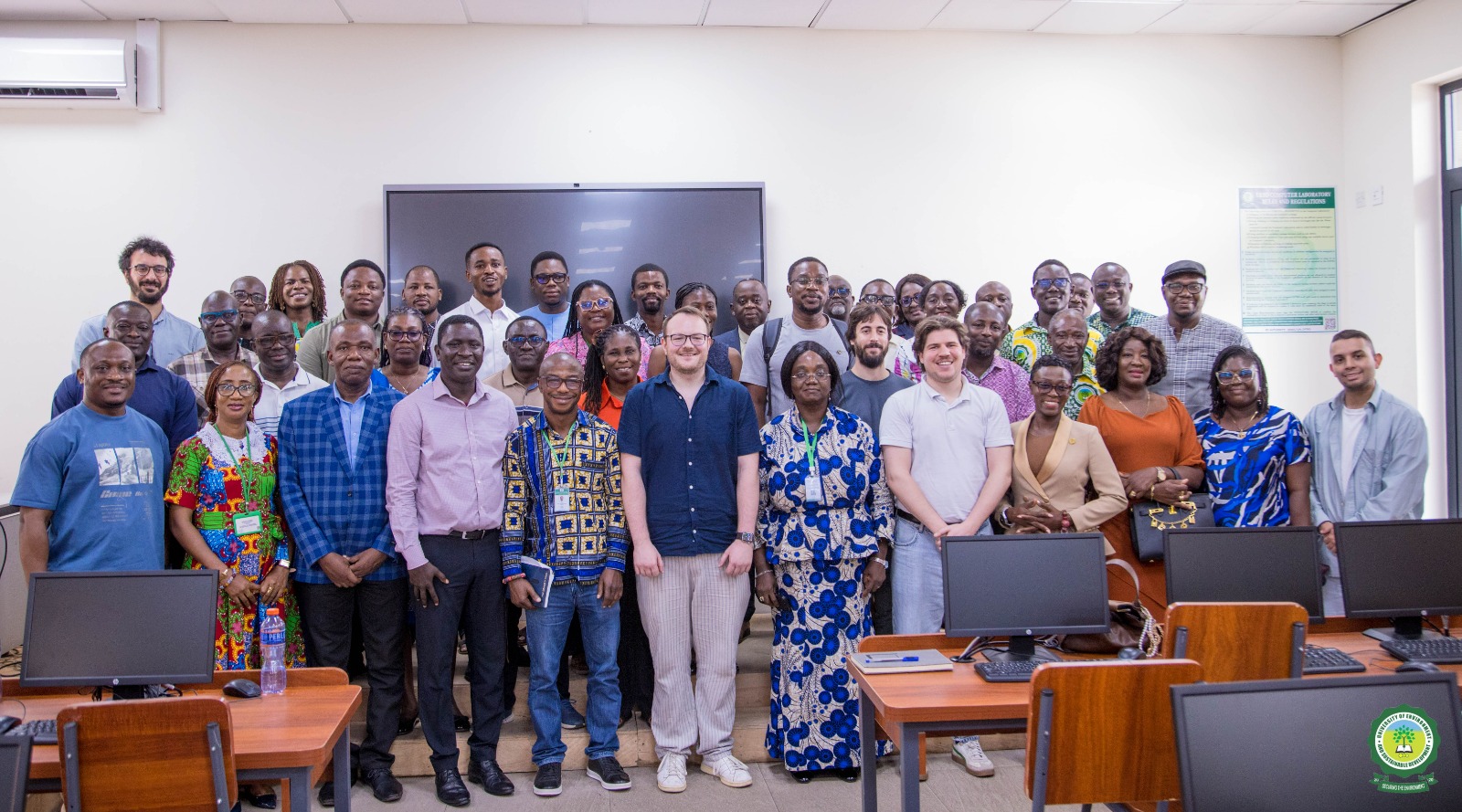
The University of Environment and Sustainable Development (UESD), Somanya, Eastern Region has hosted the closing workshop of the ImPreSSion Project, an international, European Union-funded initiative aimed at improving study programmes in Ghana through the integration of green solutions, sustainability modules, and digital transformation.
Improving Study Programmes in Ghana by Introducing Green Solutions, Sustainability Modules and Digital Transformation (ImPreSSion), a three-year project, which commenced in 2022, is an European Union-funded project with five partner Universities-three from Ghana and two from Europe. The Ghanaian institutions are UESD, the University of Energy and Natural Resources (UENR), and the University of Ghana, Legon, while the European partners are RWTH Aachen University (LFI), Germany, and Politecnico di Milano (Polimi), Italy.
The closing workshop, held at UESD’s video conference facility was attended by project members, Management and heads of Departments Divisions, Units and sectional heads. marked the successful conclusion of a collaborative effort to strengthen curricula, enhance digital teaching capacity, mainstream gender considerations, and align academic programmes with global sustainability standards. The Chairman was the Pro Vice-Chancellor, Prof. Edward Wiafe Debrah.

Presenting an overview of the project, the UESD ImPreSSion Coordinator and Head of the Department of Water Resources and Sustainable Development, Professor Michael Tuffour, traced the journey of the project from proposal development in 2021 to its successful implementation.
He explained that the ImPreSSion Project focused on curriculum development, capacity building, gender mainstreaming, and digitalisation of teaching and learning. Under the project, UESD developed a BSc. in Water Resources Development; UENR implemented MPhil/PhD programmes in Energy Sustainability; and the University of Ghana, Legon developed an MPhil in Crop Science.
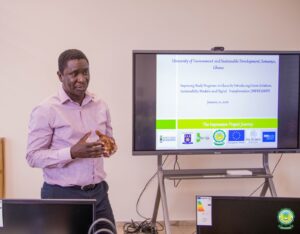
Prof. Tuffour noted that the Water Resources programme at UESD benefited significantly from stakeholder engagements, international benchmarking, and mentorship from European partners, contributing to its successful accreditation in 2024 and preparations for re-accreditation in 2026.He further revealed that the programme is being strengthened with enhanced science and engineering components, with plans to introduce Water Resources Engineering as a new programme.

The project also delivered extensive capacity-building programmes, including training in online teaching, MOOCs, sustainability pedagogy, and video-based content development. Faculty members benefited from study visits and training sessions in Germany and Italy, as well as online workshops.
Significantly, the project supported the establishment of a Gender Contact Point, contributing to UESD’s gender policy framework and the development of an anti-sexual harassment policy, alongside the formation of a University Gender Committee. In terms of infrastructure, Prof. Tuffour noted that the ImPreSSion Project facilitated the establishment of a modern video conference room, a second computer laboratory, and a digital teaching and recording studio, all of which are expected to enhance blended and online learning delivery at UESD.
Reflecting on lessons learnt, the project Coordinator, highlighted improved inter-University collaboration, stronger faculty networks, enhanced grant management capacity, and increased international visibility for UESD. “ This project has placed UESD on the European Union funding map and demonstrated our capacity to manage international grants effectively,” he said.
Prof. Tuffuor expressed appreciation to the European Union, partner Universities, UESD Management, and project team members for their dedication and support, noting that the ImPreSSion Project provides a blueprint for future international collaborations.
The Pro. Edward Wiafe Debrah, warmly welcomed the ImPreSSion delegation and partner institutions, describing UESD as “embryonic but visionary.” He reaffirmed UESD’s commitment to becoming a hub for environmentally responsible teaching, research, and community service noting that the project had provided valuable opportunities for knowledge exchange and institutional learning. “Your visit affirms our shared commitment to innovation, sustainability, and excellence in higher education. We look forward to sustaining and deepening this partnership beyond the project,” he said. The University is leveraging technology to expand access to teaching and learning, making digital delivery a core part of its academic strategy. He noted that the ImPreSSion Project should be seen as a foundation rather than an endpoint.

The Registrar of UESD, Mrs Mary Abena described UESD as “the University of the Future,” established to ensure environmental sustainability and the continued existence of humanity. He highlighted the significance of the ImPreSSion collaboration in supporting UESD’s strategic goals, particularly in the areas of digital learning, partnerships, and quality teaching delivery. Adding that, “this collaboration has brought meaning to our vision and strengthened our capacity as a young University to deliver quality education to our students and the wider community, she ended
Representatives of the other four partner institutions, in separate remarks, expressed satisfaction with the successful implementation of the project and the positive impact it has made on participating universities. They described the ImPreSSion project as the beginning of a strong partnership among the institutions and indicated their commitment to building on the collaboration, strengthening existing areas of cooperation and exploring new avenues for joint programmes, research and innovation.